
ECG Test in Nawanshahr: 7 Myths People Still Believe About This 5-Minute Test!
REVIEWED BY Dr. Amarinder Singh Saini (MBBS, MD Radio Diagnosis) on 6th october 2026.
Most people in Nawanshahr have had this moment. You go to the doctor because your chest has felt heavy since morning, or because you got breathless on the stairs and that never used to happen before. He checks your BP, listens to your chest, and writes one line on the slip: ECG karwa lo.
And somewhere between the cabin and the billing counter, the doubt starts. Is this test really needed, or has he just added something to the bill?
We hear that question at the hospital more often than you would imagine, and honestly, we understand where it comes from. Nobody has ever sat down and explained this test to people. What most families know about an ECG they have picked up from neighbours and from films, so the wires look dangerous, some current is supposed to pass through the body, and everyone agrees it is a test for buzurg log with heart trouble. Which is also why cars still leave for Ludhiana and Chandigarh every week, a whole day goes into travelling, several thousand rupees go with it, and the family comes back holding the same strip of paper we would have handed them here in fifteen minutes.
So let us go through all of it, without the medical language. What the test does, what it cannot tell you, when you actually need it, what those few minutes on the bed feel like, and the seven ideas about ECG that badly need to be put to rest.
What Is an ECG Test, in Simple Words?
ECG is short for electrocardiogram. Some reports and some doctors write EKG instead, which is only the German spelling of the same word, so do not worry if you see both.
Your heartbeat begins as electricity. Before the muscle squeezes, a small electrical signal starts near the top of the heart and travels down through it in a fixed order, and that order is what makes the chambers squeeze one after the other instead of all at once. This has been happening in you every second since before you were born.
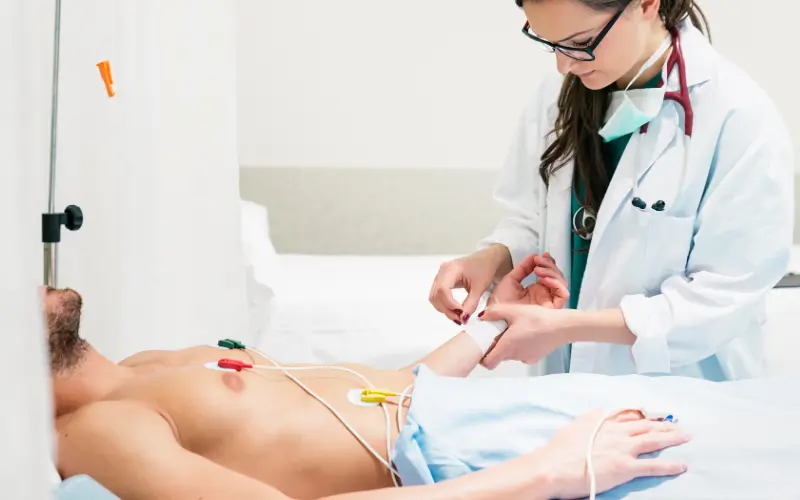
An ECG machine picks up that electricity from the surface of your skin and draws it out as a line on paper. Nothing is sent into you. No injection, no dye, no radiation, no current. The pads on your chest and limbs work the way a microphone works, by receiving something that is already there.
If you want one comparison to keep in mind, an ECG is a recording of your heart’s voice, not a photograph of your heart. It tells the doctor about rhythm and timing, and about whether some part of the muscle is struggling.
What an ECG Can Detect?
Ten seconds of that recording tells a doctor a surprising amount. It shows the rhythm, so a heart that is racing, running too slowly, or beating completely out of order (atrial fibrillation, in medical language) shows up straight away. It shows a heart attack that is happening at that moment, and that is precisely why an ECG is the first thing done for anybody who reaches casualty holding his chest. It can also show an old heart attack, one that somebody sat through at home believing it was gas, sometimes months after the event.
Reduced blood supply to the heart muscle, called ischemia, often leaves a mark on the tracing. So does a heart that has grown thick and enlarged, which is usually the price of blood pressure that stayed high for years while nobody treated it. Sometimes the trouble is not in the heart at all and the ECG still catches it: a thyroid problem, low potassium, a medicine that is affecting the rhythm. And before any operation, this is the test that tells the anaesthetist whether your heart can take anaesthesia.
What an ECG Cannot Do?
Now the part that causes most of the confusion. An ECG cannot show a blockage in your arteries. A man can have an artery narrowed by sixty or seventy percent, walk into the hospital, lie down on the bed, and get a tracing that looks entirely normal. Patients find this hard to accept, and some get annoyed, as if the test has cheated them.
It has not. An ECG is the first step and was never meant to be the last word. When the symptoms or the history suggest something more, the doctor asks for an Echo, which is an ultrasound that shows the heart’s structure, its valves and how strongly it is pumping, or a TMT, where an ECG is recorded while you walk on a treadmill so that whatever hides at rest is forced to reveal itself. Blood tests such as troponin come in when a heart attack is suspected.
The ECG goes first for a very ordinary reason. It takes five minutes, costs almost nothing compared to the rest, carries no risk at all, and can be done the minute you arrive. It answers the urgent question, and then it tells the doctor whether anything deeper is needed.
Myth vs Fact: 7 Things People in Nawanshahr Still Get Wrong About ECG

Myth 1: “The machine gives a current or shock to the body.”
The machine only receives. It does not put anything into you, so there is no shock, no current and no radiation. The only sensation you will notice is cold gel and a few pads sitting on your skin.
We know where this fear comes from, though. In films somebody is dying, a doctor presses two paddles on the chest, the body jerks, and everybody in the hall remembers it. That machine is a defibrillator, it is used when the heart has actually stopped, and the only thing it has in common with an ECG is a chest and some wires.
Myth 2: “ECG is only for old people.”
Indians develop heart disease roughly ten years earlier than people in Western countries. In Punjab that is no longer a statistic in a journal, it is what doctors see in the OPD: attacks at 38, at 35, occasionally younger than that. And look at what surrounds us. Ghee and sugar in most kitchens, BP and diabetes in a large share of households, tobacco, work that keeps a man sitting for ten hours, and stress that nobody in the family will call stress.
Age is not what decides who needs this test. Symptoms and risk factors decide it. A 32-year-old with chest pain needs an ECG today. A 70-year-old with no complaints, whose checkup last year was fine, can wait for his yearly visit.
Myth 3: “The doctor wrote it just to increase the bill.”
This is the belief that actually costs lives, so we will answer it properly instead of politely.
Consider the arithmetic for a second. An ECG is among the cheapest items on any hospital’s rate list. A hospital interested in inflating your bill has a dozen better ways of doing it than this one. The test gets written because it is the fastest way to rule out something that could finish you by evening, and because in heart disease the clock is everything. Come to us in the first hour of an attack and a good part of the muscle can still be saved. Come the next morning, after a night of antacids and hoping, and no treatment anywhere in the world brings that muscle back.
There is also no choice in the matter. Chest pain, breathlessness, a fainting spell: each of these needs an ECG before the patient walks out of the hospital. A doctor who skips it to keep your bill small is not doing you a kindness, he is gambling with you.
Myth 4: “My ECG was normal, so my heart is perfectly fine forever.”
An ECG records about ten seconds of your heart’s life, taken while you lie quietly on a bed. Ten clean seconds are worth having. They are still only ten seconds.
A normal report is good news and you should take the relief that comes with it. What it does not promise is that your arteries are clear, or that the same tracing will appear six months from now. This is why a doctor reads your ECG together with your symptoms, your BP, your sugar, your family history and whatever he finds on examination, rather than treating it as a certificate on its own.
So if the report said normal and the pain keeps returning, come back. Bring the old strip with you, because a comparison between two tracings often tells us more than either one alone.
Myth 5: “It is a painful test.”
There is nothing in the test that can hurt you. Ten pads, a little gel, half a minute of lying still.
The only complaint we ever get is from men with hair on the chest when a pad is peeled off at the end, and our technicians are careful about that. That is the entire extent of the discomfort involved.
Myth 6: “It will take hours and I will lose the whole day.”
The recording takes ten to thirty seconds. Lying down to walking out with the printout in your hand is usually under five minutes, and that includes putting your shirt back on. No fasting, no preparation, no injection, no rest afterwards. People come in during a lunch break and go back to work with the strip folded in their pocket.
Myth 7: “For a reliable heart test, you must go to a big city.”
Not any longer, and this is the sentence we would underline if we could.
An ECG is reliable when three things are in place: a proper 12-lead machine, a technician who puts the leads in the correct positions, and a doctor who reads the tracing against your history instead of in isolation. All three are here in Nawanshahr, at Raja Hospital.
Driving three hours with chest pain is not being extra careful about your health. It is spending the most valuable hour you have on a highway, in traffic, with nobody around who can help if things turn. Big city, small town, the tracing looks the same. What differs is how quickly somebody sees it.
Is an ECG Safe? Yes, Completely
Since this is the fear that keeps most people away, let us be plain about it.
There is no radiation in an ECG. An X-ray emits something, a CT scan emits something, an ECG emits nothing at all. No electricity enters your body either, because the machine is only recording what your heart is already producing. Nothing is injected, nothing is swallowed.
It is done for pregnant women routinely and cannot reach the baby. Children have it done, very old patients have it done, and people already on heart medicines have it done regularly. It can also be repeated as often as needed. Once a day, or three times in one afternoon during an emergency, makes no difference, because nothing accumulates in the body afterwards.
There is no list of side effects for us to give you here. The only real danger connected with an ECG is not having one when you needed it.
When Should You Get an ECG Test?
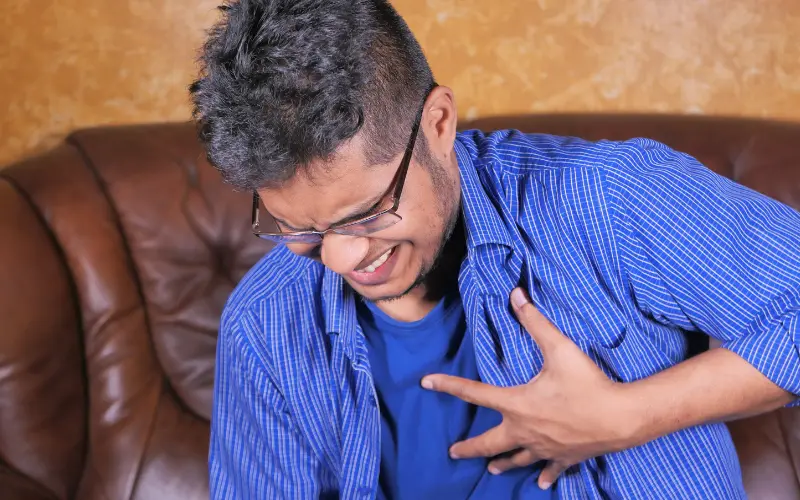
An ECG helps check your heart’s rhythm and electrical activity. If you experience chest pain, breathlessness, dizziness, or irregular heartbeat, your doctor may recommend one.
Symptoms You Should Not Delay On
See a doctor and get an ECG done if any of this sounds like your situation:
- chest pain, pressure, heaviness or a squeezing feeling, particularly if walking or climbing makes it worse
- breathlessness during things that never used to trouble you, like walking to the market or one flight of stairs
- palpitations, meaning the heart fluttering, racing, thumping, or seeming to skip beats
- chakkar, light-headedness, or actually fainting
- a sudden cold sweat along with a feeling that something is badly wrong, which is a feeling worth trusting
- pain moving into the left arm, shoulder, jaw, neck or upper back
- tiredness you cannot explain, which in women and in diabetic patients is very often the only warning that comes
- gas or acidity that antacids are not settling, especially after 40 or with diabetes
One warning before you read further. Chest pain that lasts more than a few minutes, or arrives with sweating and breathlessness, or spreads into the arm or the jaw, is an emergency and not something to watch overnight. Do not wait for the morning OPD, and do not drive yourself. Get somebody to bring you in.
Even If You Feel Completely Fine
Even with no complaints at all, an ECG is worth adding to a yearly checkup for anyone past 40, and for anyone living with blood pressure, diabetes or high cholesterol, since all three strain the heart quietly for years before you feel anything. The same applies if heart disease runs in the family, particularly a father, mother, brother or sister who had an attack before 60.
We would also suggest it for anyone who uses tobacco or gave it up recently, for people carrying a lot of extra weight or living a desk-and-stress life, for patients on long-term medicines that affect heart rhythm, and for anyone about to start serious gym training after years of doing nothing. That last one gets ignored a lot. A body that has been idle for a decade should be checked before it is pushed hard.
Before Surgery and For Fitness Certificates
Any procedure that involves anaesthesia needs an ECG beforehand. A hernia, a caesarean, even a cataract. The anaesthetist has to know how your heart is likely to behave once you are under, and there is no way to guess that from the outside.
It is the same for visa medicals, jobs abroad, insurance checkups and most employment fitness forms. So when you see ECG written on your pre-surgery list, that is a safety rule the hospital has to follow, not a line somebody slipped in.
What Actually Happens During an ECG
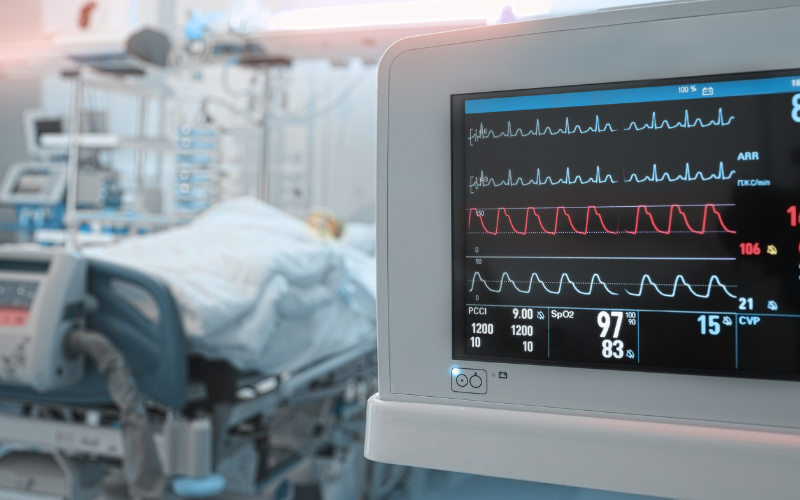
Most of the fear goes away once somebody tells you what is coming, so here is the whole thing.
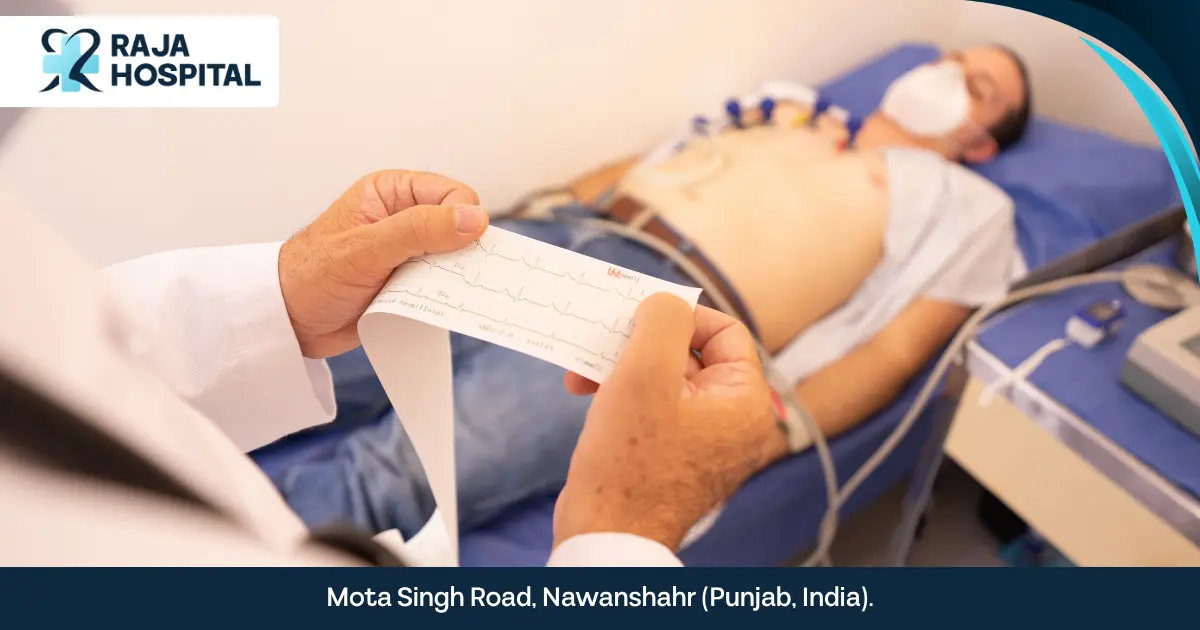
You lie down on a bed in a quiet room. Men remove their shirt; women are given privacy and a female attendant stays in the room throughout. The technician wipes a few small patches of skin on your chest, wrists and ankles and dabs some gel on them, then attaches ten pads. Between them, those ten pads give the machine twelve views of your heart, which is where the name 12-lead comes from.
Then you lie still and breathe normally for about half a minute. That is the only thing asked of you, and there is a reason for it: talking, laughing or shivering blurs the lines and the whole thing has to be repeated. The machine records, prints within seconds, the pads come off, you put your shirt back on and you are done. Nothing to avoid afterwards, nothing to watch out for.
How to Prepare
There is not much to prepare, but a few things help. Wear something loose that comes off the upper body easily. Skip oil, cream or powder on the chest that morning, because pads do not stick to greasy skin and a loose pad gives a messy tracing. Bring your medicines along, or at least the strips, since some of them visibly change the tracing and the doctor needs to know what you are taking.
Go easy on tea, coffee and cigarettes in the hour before, as they push the heart rate up for a while. Eat normally, though. Fasting has nothing to do with this test. And if you have rushed in or come up the stairs, sit for five minutes before lying down.
Understanding Your Report Without Panicking
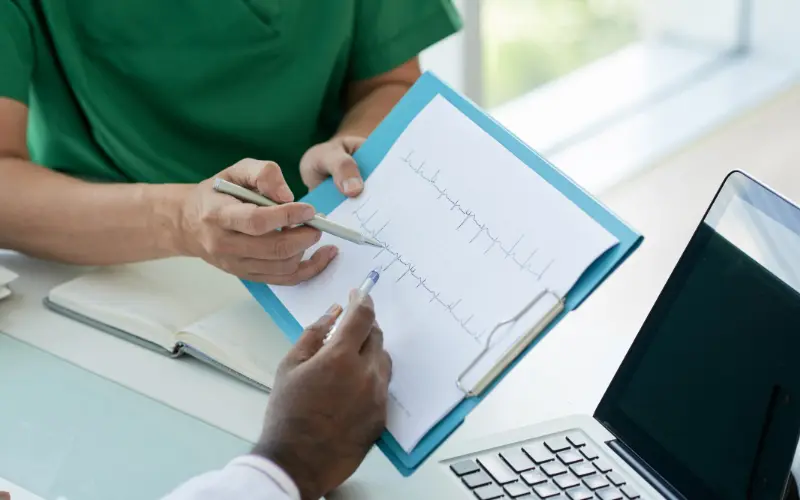
You will come out holding a long strip of paper with spiky lines running across it and a few printed words at the top. Before you start reading it in the corridor, two things are worth knowing.
The printed comment at the top is not a diagnosis. Every machine runs its own automatic reading and it is deliberately over-suspicious, because a machine that misses things is far more dangerous than one that flags too much. It will happily print phrases like possible left atrial enlargement or non-specific ST-T changes on tracings that a doctor looks at and calls entirely normal for that patient. Treat that line as a note meant for the doctor.
The second thing is that the same tracing means different things in different people. A heart rate of 52 is worth investigating in a 70-year-old on BP tablets and is perfectly healthy in a young man who runs every morning. Small variations are extremely common and most of them mean nothing at all. Everything depends on the person around the tracing.
Which brings us to a request. Please do not photograph the strip and start searching online for what the waves mean, and please do not circulate it on WhatsApp for opinions from relatives. Both roads end either in a sleepless night for no reason, or in false comfort when something did need attention. Show it to the doctor who examined you. That conversation takes ten minutes and it is the actual point of doing the test.
Why Choose Raja Hospital for Your ECG in Nawanshahr

There is no reason to spend a day on the road for a test that takes five minutes, so here is what staying in town gets you.
The machine is a modern 12-lead unit and it sits inside the hospital, not in a diagnostic centre across town that you have to visit separately. Our technicians run ECGs every single day of the week, and that matters more than people realise, because badly placed leads are one of the commonest reasons an ECG misleads a doctor anywhere in the world. You get the tracing and the doctor’s reading in the same visit, so you go home knowing what it says rather than holding paper you cannot interpret.
If the ECG points towards something more, the Echo, the TMT, the blood work and the specialist consultation are all in the same building. Nobody hands you a referral slip and a week’s wait in another city.
For anybody who arrives with chest pain, the ECG is done on arrival and the paperwork follows afterwards. That order is deliberate, because minutes are what decide outcomes in heart cases.
And you will be told what it costs before it is done. We will also only ask for a test when there is a medical reason for it, which we are saying out loud because we know perfectly well that it is the first thing people wonder about.
Frequently Asked Questions
1. How much does an ECG cost in Nawanshahr?
It is one of the cheapest tests in the hospital. Call us for the current rate, and you will be told the figure before anything is done.
2. Do I need to fast before it?
No. Eat and drink as you normally would. Just avoid a strong cup of tea or a cigarette immediately before.
3. How soon do I get the report?
The printout is ready in seconds. With the doctor’s reading, you will have your answer in the same visit.
4. Can I get an ECG without a prescription?
Yes, you can walk in and have one done. We would still push you to sit with a doctor afterwards, because an ECG nobody reads helps nobody.
5. Is it safe during pregnancy?
Completely. No radiation, nothing that can reach the baby. It is done for pregnant patients all the time.
6. My report is normal but my chest still hurts. Now what?
Go back to your doctor and take the old report with you. A normal resting ECG does not rule out a blockage, and an Echo, a TMT or blood tests may be the next step.
7. What is the difference between ECG, Echo and TMT?
An ECG records the heart’s electrical activity while you rest. An Echo is an ultrasound showing the heart’s structure, its valves and how strongly it pumps. A TMT records an ECG while you walk on a treadmill, which catches problems that only appear under strain.
8. Do you do ECGs at night?
Yes. Anyone who arrives with chest pain or heart symptoms gets one immediately, whatever the hour.
Struggling with same?
Book Your Appointment With Our Expert Doctors

Conclusion
Hearts almost never fail without giving some notice first. There is usually a heaviness somebody ignored, breathlessness that got blamed on the weather, thakaan that got blamed on work, gas that was never gas.
An ECG is the quickest and cheapest way to listen to those warnings while something can still be done about them. Five minutes, no pain, no radiation, no side effects, and no need to leave Nawanshahr for it.
So if your chest has not felt right lately, or you are past 40 and have never had your heart looked at, or a doctor wrote ECG on a slip weeks ago and that slip is still lying in a drawer somewhere, get it done this week.
Come to Raja Hospital, Nawanshahr, or call us and we will book your ECG along with a consultation. Your heart has not taken a single break since before you were born. Give it five minutes.